

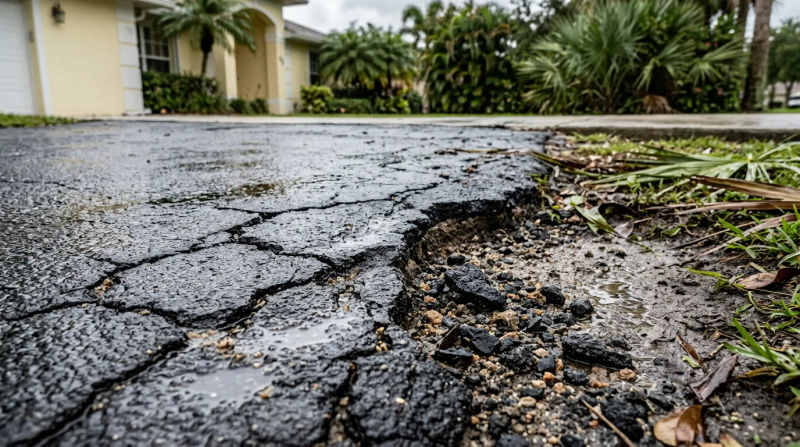
You pull into your driveway after a heavy September downpour, the kind we know all too well here in West Palm Beach. As the sun comes out and steam rises from the pavement, you notice something isn't right. The small crack you’ve been ignoring seems wider, and the surface looks rougher, with loose bits of stone scattered near the edges. These are more than just cosmetic issues; they are important asphalt warning signs that your pavement is trying to send you.
Here in South Florida, our climate is tough on asphalt. The combination of intense sun, high humidity, and torrential rains, especially during the late hurricane season, can accelerate pavement breakdown. Moisture and heat are a potent duo that attacks the binding agents in your asphalt, leading to rapid deterioration. Ignoring these early signs often leads to more extensive and costly repairs down the road. As a paving supervisor with over 15 years of experience in this region, I’ve seen how quickly minor issues can escalate. Understanding what to look for is the first step in protecting your investment.
Common Signs and Symptoms
Regularly inspecting your driveway, especially after significant weather events, allows you to catch problems early. Our trained crews have a standardized process for identifying these issues during an assessment. Here’s what you should be looking for:
- Alligator Cracking: This is one of the most serious forms of asphalt damage. It appears as a network of interconnected cracks that resemble the scaly pattern on an alligator's back. This type of cracking is rarely just a surface problem; it almost always indicates a failure in the underlying layers of the pavement.
- Raveling: Does your asphalt surface look coarse and feel bumpy? Are there loose stones or gravel on top? This is called raveling. It occurs when the fine aggregate and asphalt binder wear away, exposing the larger stones beneath. It often starts in small patches but can spread across the entire surface, leaving it weak and porous.
- Linear (or Longitudinal) Cracks: These are single, long cracks that typically run parallel to the length of the driveway. You might see them down the center or near the edges. While less immediately alarming than alligator cracking, they are direct entry points for water, which will erode the sub-base over time.
- Potholes: Everyone knows a pothole when they see one. These bowl-shaped depressions form when surface damage worsens, allowing water to penetrate and weaken the base. The weight of vehicles then breaks up the weakened pavement, which is eventually displaced, leaving a hole.
- Depressions and “Bird Baths”: These are shallow, low-lying areas on the pavement surface. You’ll notice them most after it rains, as they collect water, forming puddles or “bird baths.” These depressions are not just a nuisance; the standing water accelerates the breakdown of the asphalt in that area.
- Faded, Gray Surface: New asphalt has a rich, deep black color. Over time, exposure to sunlight causes oxidation, which dries out the essential binding oils. The pavement becomes brittle and turns a faded gray color. This is a sign that your asphalt has lost its flexibility and is more susceptible to cracking.
- Upheaval: The opposite of a depression, an upheaval is a swell or bump in the pavement surface. This is often caused by moisture swelling the clay in the soil beneath the asphalt, particularly in areas with poor drainage. This is a common issue in Florida due to our high water table and saturated ground.
What Causes This Problem
Understanding the root cause of these symptoms is key to implementing a lasting solution. Simply patching a problem without addressing the underlying issue is a temporary fix at best.
The primary culprit behind most asphalt failure is water. Our heavy Florida rains create a constant threat. Water infiltrates through tiny cracks, saturating and softening the sub-base layer that supports the asphalt. When a vehicle drives over the wet, cracked area, it creates hydraulic pressure that forces the water around, eroding the base material and making the cracks larger.
Another major factor is oxidation from sun and heat. The relentless Florida sun beats down on your driveway, and its UV rays break down the asphalt binder - the glue that holds the stone aggregate together. This makes the pavement brittle and less able to withstand traffic and temperature changes. This process is what leads to raveling and a faded appearance.
Structural and age-related issues are also significant. The alligator cracking causes we see most often are related to a compromised foundation. This could be due to a sub-base that was too thin or poorly compacted during the initial installation, or one that has been weakened by long-term water intrusion. For many properties in the West Palm Beach area, especially those built during the suburban boom of the 1970s and 1980s, original driveways are now well past their expected lifespan. Their foundations have endured decades of use and weather, making them prime candidates for this type of structural failure.
Finally, improper drainage contributes heavily. If your property isn't graded correctly, water will pool on the asphalt instead of running off. These standing “bird baths” constantly saturate the pavement, leading to localized raveling, depressions, and eventually, potholes.
When to Call a Professional
Knowing when to call for asphalt repairs can save you significant money and prevent a small problem from becoming a total pavement failure.
Some minor maintenance can be handled by a diligent homeowner. For instance, filling a few very fine, isolated cracks (less than a quarter-inch wide) with a high-quality sealant from a hardware store can help prevent initial water intrusion. However, this is purely a preventative measure for pavement in otherwise good condition.
It's time to contact an experienced professional when you see any of the following:
- Alligator Cracking: This is a non-negotiable sign of deep structural problems. A surface patch will not work. A professional crew needs to assess the failure, which often involves cutting out the damaged section, repairing the sub-base, and installing new, properly compacted hot-mix asphalt.
- Widespread Raveling: If the surface is rough and losing aggregate across large areas, a simple sealcoat may not be enough. This often requires professional surface treatments like an overlay. There are effective asphalt raveling fixes, but they require specialized equipment and materials to bond a new layer to the old one properly.
- Multiple or Large Potholes: Patching one small pothole is one thing, but multiple or expanding ones indicate a systemic issue with water penetration and base failure.
- Large Cracks or Depressions: Any crack wider than half an inch or any area where water consistently pools needs a professional evaluation. The problem is likely related to the sub-base or poor drainage, which requires more than a simple patch.
Our technicians are trained to diagnose the root cause. An organized workflow involves not just looking at the crack itself, but evaluating the surrounding drainage, the condition of the sub-base, and the overall age and health of the pavement to recommend a solution that lasts.
Conclusion
Your asphalt driveway is a significant part of your home’s curb appeal and functionality. Paying attention to the early asphalt warning signs - like alligator cracking, raveling, and water pooling - is crucial, especially in our demanding South Florida climate. The heavy rains of September and the late hurricane season often reveal vulnerabilities that have been developing all year.
Remember that many of these issues, particularly alligator cracking, are symptoms of deeper structural problems that surface patches can't resolve. Acting early and addressing the root cause is always more effective and economical than waiting for a complete failure that requires a full replacement.
If you notice any of these signs, contact a local Asphalt Paving professional for an inspection. An expert can accurately diagnose the problem and recommend the most durable and cost-effective solution to restore the safety and integrity of your pavement.